Uncategorized
Best Drone for Real Estate Photography: Why the DJI Mini 4 Pro Is Worth a Look
Jul
If you shoot real estate listings for a living, your drone isn’t a toy it’s a business tool. It needs to launch fast, fly predictably, and hand you footage that makes a $10 million listing (or a starter home) look its absolute best. After years of relying on a bulkier, heavier rig, one real estate videographer recently made the switch to the DJI Mini 4 Pro, and the results say a lot about where compact drones have landed in 2025.
Here’s a breakdown of why this drone has become a favorite for real estate work, where it falls short, and who it’s actually right for.
The Backstory: Trading a Tank for Something Lighter
For years, many real estate shooters have leaned on drones like the Mavic 2 Pro or Mavic 3 sturdy, reliable, and genuinely tank-like in build quality. Durability was never the issue. But that durability comes at the cost of size and weight, and there’s a particular kind of stress that comes with flying something heavy and expensive over someone else’s very expensive house.
That’s the appeal of the Mini 4 Pro: it trades bulk for portability without giving up much on image quality, at least for the kind of shots real estate work actually demands.
What Makes It Great for Listings
It’s built for speed and simplicity. Unfolding it takes seconds, there’s no fumbling with propellers, and the battery slots in and out easily. For a job where you’re often shooting multiple properties in a single day or squeezing in a shoot before golden hour disappears that kind of frictionless setup matters more than it sounds like it should.
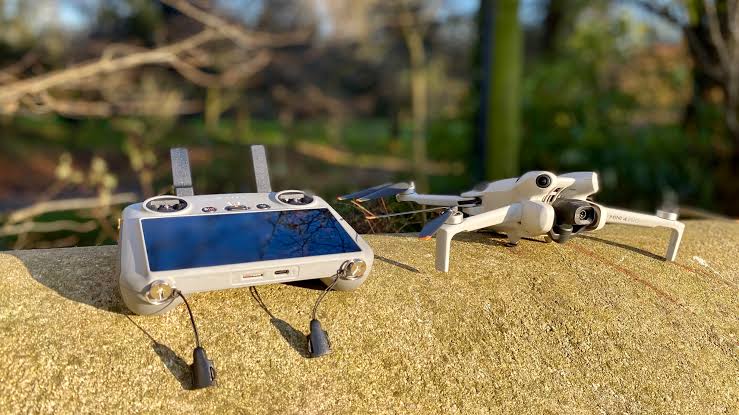
The controller is a genuine upgrade. Flying via a phone screen (the old way) versus a dedicated controller with its own touchscreen is a night-and-day difference. It connects directly to Wi-Fi or a hotspot, and having a proper physical remote instead of a phone clipped to a controller makes flights feel more stable and more professional.
Battery life supports a full shooting day. Each battery lasts roughly 20–30 minutes, and with three batteries in the Fly More Combo, you get close to 90 minutes of total flight time. That’s enough to cover a daylight shoot, a golden-hour pass, and a twilight shot of the same property without scrambling to recharge mid-session.
Image quality holds up. The Mini 4 Pro shoots D-Log 4K at 60fps, along with a 100fps slow-motion 4K mode, and performs surprisingly well in low light and at twilight a key selling point for listing videos, since golden hour and blue hour shots are often what sell the emotional appeal of a home. Built-in color profiles make grading straightforward, so the footage looks polished with minimal post-production work.
It’s genuinely versatile indoors and out. Because it’s small and light, it’s far less intimidating to fly through interior spaces hallways, foyers, larger open-concept homes than a full-size drone. It won’t replace an FPV drone for tight interior work, but for most listings it opens up shots that heavier drones simply can’t attempt safely.
Home Point tracking is a small but real convenience. For anyone who’s ever lost track of exactly where they took off from mid-flight, having a marked home point on the map saves real time when you’re trying to reorient at altitude.
Sub-249g weight matters more than people expect. Because it falls under the 249-gram threshold, it sidesteps a lot of the registration and certification requirements that apply to heavier drones a genuinely useful perk for someone building a real estate photography business without extra red tape.
Where It Falls Short
No drone is perfect, and there are two real trade-offs worth knowing before you buy.
It’s fragile. The lightweight plastic build that makes it so portable also makes it more vulnerable to damage. A hard impact or an awkward twist during setup could cause real damage, so a hard case and a gimbal cover for transport aren’t optional extras they’re necessities.
Wildlife and wind are bigger threats than usual. Because it’s small and light, it’s more vulnerable to birds (crows and seagulls in particular) and even swarms of bees, which apparently tend to hover at similar altitudes. Wind is also more of a factor the Mini 4 Pro handles moderate wind well, but in genuinely gusty conditions, a heavier drone like the Mavic 3 is the safer choice.
Specs Worth Knowing
- Sub-249g weight (no FAA registration required in most cases)
- 4K/60fps video, with 4K/100fps slow motion
- Strong low-light and twilight performance
- Photo bracketing built in
- Vertical shooting mode for Reels/Shorts/TikTok
- Digital zoom
- Up to 34 minutes of flight time per battery (manufacturer rating)
- Automated shooting modes (Dronie, Rocket, Circle, Helix, Boomerang, Asteroid, Dolly Zoom) plus ActiveTrack
Who Should Buy It
The Mini 4 Pro is a strong fit for:
- Real estate photographers and videographers just starting out
- Agents or small teams building a content workflow on a budget
- Anyone who wants professional-looking aerial footage without the learning curve (or liability) of flying a heavier drone
It’s less suited to shooters who need maximum durability in high-wind regions or who are chasing the most cinematic possible footage for that, something like the Mavic 3 Pro, with its longer zoom range and larger sensor, is still the better tool.
The Bottom Line
For the vast majority of real estate listings regular homes, mid-size properties, even the occasional luxury estate the DJI Mini 4 Pro hits a sweet spot of image quality, ease of use, and affordability that’s hard to beat. It’s not indestructible, and it’s not the drone for every situation, but as an entry point (or an upgrade from a phone-controlled setup) for real estate content creation, it’s earned its reputation as one of the best drones on the market right now.
